

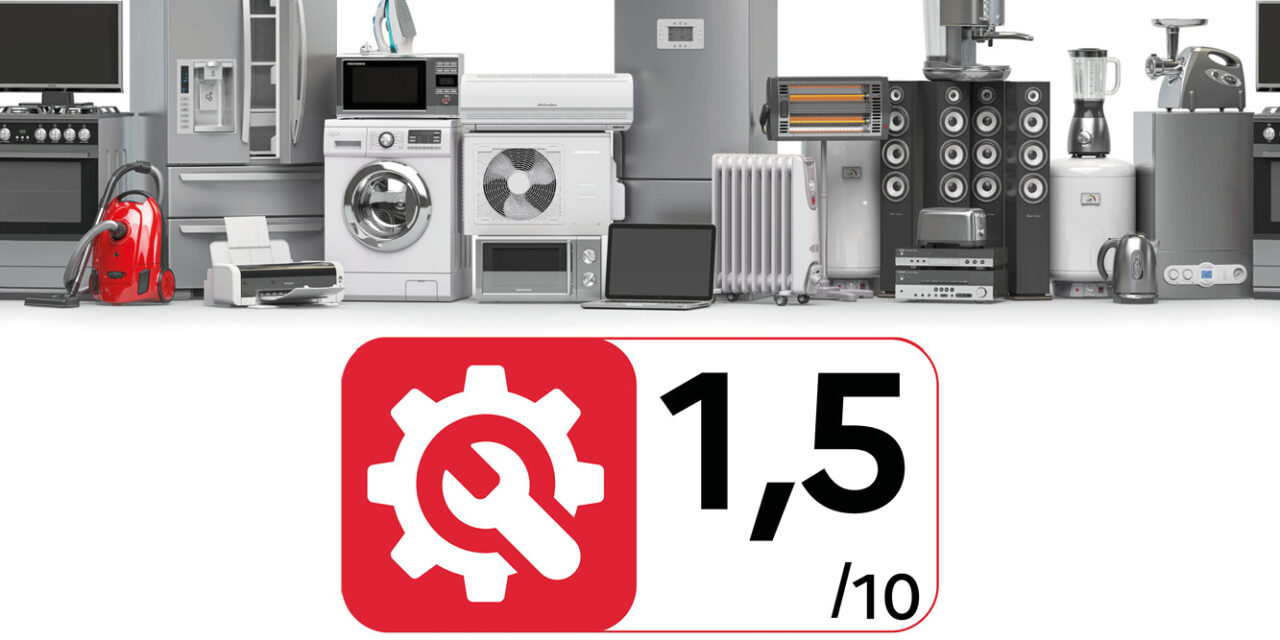
What Is a Product’s “Repairability Index”?
The repairability index is a European score that penalizes (or rewards) a manufacturer based on how easily a product can be repaired. It assesses whether a repair technician—or a handy DIY enthusiast like you and me—can easily open the device, access spare parts at a reasonable price, and replace them without too much difficulty. Technical documentation such as guides and videos is also taken into account when determining the score.
The repairability index was created in France in 2021 to help consumers make more informed choices. However, as of 2023, it is mandatory for only eight product categories: smartphones, washing machines, laptops, lawnmowers, dishwashers, televisions, pressure washers, and vacuum cleaners. This French initiative is gradually gaining attention in other European countries, but we are still far from seeing a unified Europe-wide standard.
In short, the repairability index helps guide your purchasing decisions by making you aware of whether the product you’re interested in can be repaired easily—or whether it will simply end up at the landfill once the warranty expires.
What About the Repairability of Sous-Vide Immersion Circulators and Other Sous-Vide Equipment?
Unlike most small kitchen appliances, an immersion circulator is exposed to intense stresses: heat, steam, and often continuous use for many hours. If the unit is poorly designed or built with low-quality components, it will inevitably fail sooner or later.
Since around 2011, the global market has been flooded with low-cost sous-vide machines produced in China (see my article on how to identify the origin and quality of an immersion circulator). Today, you can buy one for under €100—sometimes even under €50. Unfortunately, quality is often not part of the package. Numerous breakdowns are reported on forums and Facebook groups. The most common issues involve heating element failures, unreliable control buttons, inaccurate or unstable temperature regulation, poor resistance to steam, or problematic Wi-Fi/Bluetooth connectivity.
These devices are so inexpensive that, during the warranty period, it simply isn’t worth a retailer’s time to collect the defective unit, open it, identify the problem, replace the faulty component, reassemble it, test it, and send it back. Who would do all that for a device sold at €50? Retailers generally just replace the circulator with a new one, and the faulty one goes straight to the trash.
Outside the warranty period, the cost of repairing a low-end circulator can be so discouraging that you’ll naturally feel tempted to buy a new one and throw the old one away. What’s worse, these low-cost units are usually designed with no intention of being repairable. This means that even with all the goodwill in the world, trying to fix one yourself can turn into a nightmare.
Why Repairability Matters
It is simply not acceptable to throw away a machine when a tiny component worth a few cents or euros could easily be replaced by someone with basic skills. Our mindset needs to change. We must start caring about the repairability of the products we buy. This is not some “eco-activist fad”—it’s common sense, and it can even be a fun and rewarding activity.
Currently, there is no repairability index for immersion circulators or other sous-vide equipment—and there likely never will be. But nothing prevents us, individually, from contributing to a culture of repair.
This is why, on this information website, I will always include a “Repairability” section when presenting products. Either I will have personally tested the repairability of a unit I own or have owned, or I will have contacted (anonymously) the manufacturer and/or retailers to gather all the necessary information, which I will include in my articles.
If you have your own experiences—positive or negative—feel free to share them with me in the comments section of each article. I’ll be happy to exchange with you.






Recent Comments