

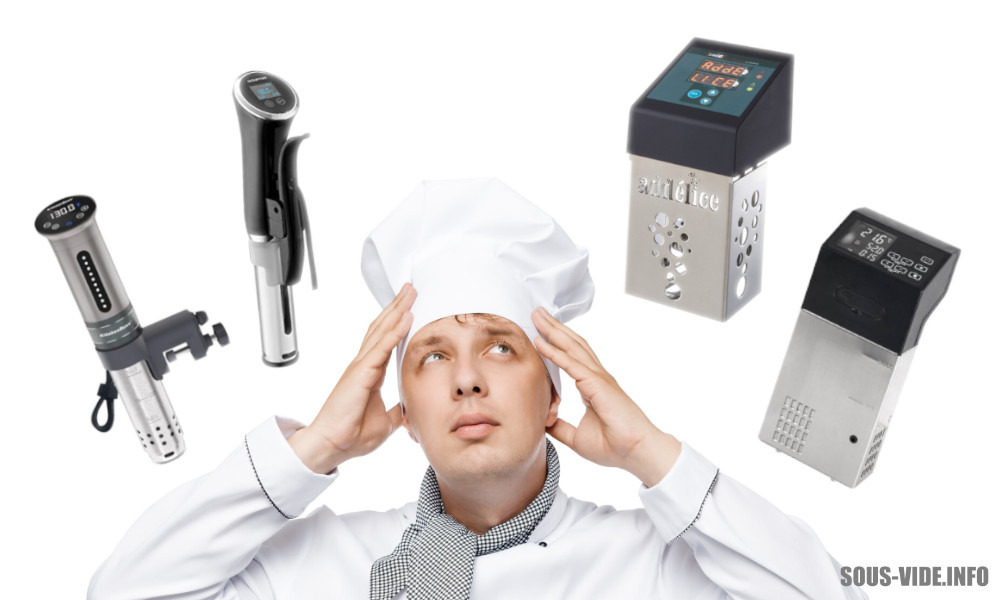
In a previous post (1/2) I explained why the criteria of the origin of an immersion circulator was important. In this post we will review several objective criteria to consider when choosing an immersion circulator suitable for use at home or in a professional kitchen:
1. Power
2. Accuracy and stability
3. Water-resistant devices
4. Connectivity (Bluetooth, Wi-Fi)
5. After-sales service and repairability
1. POWER OF AN IMMERSION CIRCULATOR
The power of sous vide cooker sold on the market varies between 800 and 2,400 W.
Which power to choose?
To answer this question you must first understand that an immersion circulator heats at full power only during the temperature rise phase of the water-bath. Then, when the desired temperature of the water-bath is reached and stable, the immersion circulator uses very little power (about 50 W/h depending on the volume, the temperature of the water-bath and the insulation of the container). Contrary to popular belief, an immersion circulator is quite economical to use, even for long cooking times.
Could we then say that an individual, or a professional, with a hot water tap at 55°C could manage without a powerful immersion circulator? Indeed, filling your container with hot or lukewarm water will save you precious time during the heating phase of your water-bath. But if you are a professional and you need to heat a large volume of water (28 or 58 L) and/or you are targeting “high” temperatures (for pasteurization or for cooking vegetables purposes), then a powerful immersion circulator will be essential.
To sum up, a powerful immersion circulator is like a car with a big engine, we don’t use it all the time, but when we need it we’re happy to have some power in reserve!
My recommendation: 1,800 W maximum power for an individual and 1,800 W minimum for a professional, 2,400 W being a plus.
2. Accuracy and stability of an immersion circulator
These are 2 fundamental criteria that are often overlooked in product descriptions.
The accuracy of an immersion circulator depends on the quality of the temperature measurement system and the thermal probe.
Stability is the ability of an immersion circulator to maintain the temperature of a water-bath while undergoing external constraints such as a draft or the immersion of vacuum pouches at 3°C (27°F) in a water-bath set at 58°C (136°F)…
Accuracy of the temperature of an immersion circulator
Sous Vide Cooking is all about precision. A difference of 1°C (1.8°F) between the display of your sous vide cooker and the actual temperature of the water-bath can lead to approximate and disappointing results on certain food stuff.
Most immersion circulators users are unaware that their sous vide equipment can become inaccurate after a few years. Sometimes an immersion circulatoer can be incorrectly calibrated from the first use! To properly test the accuracy of an immersion circulator you need a very special thermometer. During my first tests, about ten years ago, it was difficult to obtain, as an individual, a precision thermometer. I had been able to borrow a Greisinger GMH 3750 thermometer with an accuracy of ± 0.03°C and a platinum probe Pt100 DIN B ± 0.10°C. Then I recently bought myself a thermometer dedicated to sous vide cooking (the SWAT) with a Pt1000 ± 0.10°C probe. These devices are extremely precise and cost several hundred euros!
If you test your immersion circulator with a regular kitchen thermometer, this will not bring you any relevant information. Why?
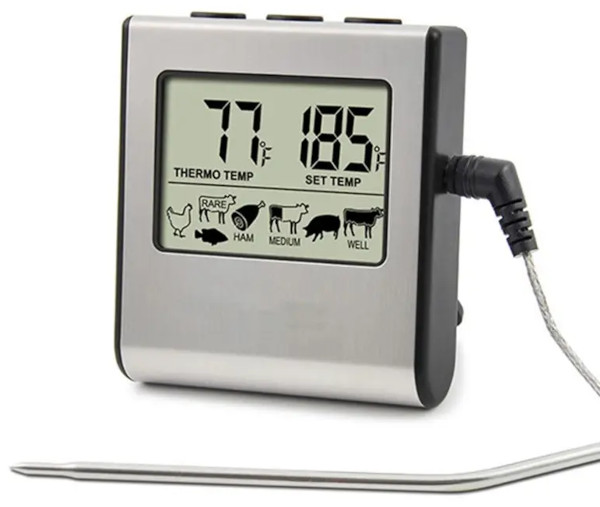
– Your entry-level kitchen thermometer is not a precision thermometer! Sorry, but many people trust their thermometer without having looked at the technical specifications. I’ll give you an example: the kitchen thermometer on the picture below, which is found everywhere, has an accuracy of ± 1°C (± 1.8°F). This means that, potentially, when you test your bain-marie at 54°C (129.2°F) your thermometer may indicate a temperature between 53 (127.4) or 55°C (131°F)…
– A precision thermometer with a type K thermocouple probe can, for many reasons, become inaccurate over time (± 1.5°C or ± 2.7°F). Professionals aware of this problem (and especially those working in a HACCP environment “Hazard Analysis Critical Control Point”) require the calibration of their thermometer every 2 years, at least!
– Another reason: when an immersion circulator manufacturer announces an accuracy of ± 0.3°C (± 0.54°F), this means that a user can be at + 0.3°C (+ 0.54°F) while another user of a device of the same model can be at -0.3°C (- 0.54°F compared to the actual temperature). This still makes a difference of 0.6°C (1°F) between these 2 immersion circulators! If you add to this the “imprecision” of your thermometer (± 1°C or ± 1.8°F) which is used to measure the accuracy of your immersion circulator… then it gets complicated!
In conclusion, if you see an entry level sous vide cooker technical data with an accuracy of ± 0.1°C (± 0.18°F) or 0.05°C (± 0.09°F)”…it’s a joke! This level of accuracy can only be achieved with high-end equipment containing high-tech components.
From experience, immersion circulators whose prices are lower than 250 €, have an accuracy that could be described as acceptable to mediocre for use in the sous vide technique.
The problem is also due to the loss of accuracy of the temperature of the immersion circulator over time. Remember to check the calibration of your immersion circulator immediately after purchase and then 2 to 3 years later with a thermometer that you can be sure is properly calibrated.
It is generally not possible to recalibrate an “entry level” immersion circulator. At worst, you can put a sticker on your immersion circulator with +0.5°C (+1°F for example) writtzn on it, to inform the user that he must add 0.5°C (+1°F) when setting the target temperature of the water-bath.
The best sous vide cookers on the market have a platinum temperature probe (Pt100) which does not lose (or very little) accuracy over time.
Temperature stability in the water bath
It all depends on the quality of the temperature controller (the electronics of the immersion circulator) and the programming of the software. Temperature stability of less than 15 liters water-bath does not generally pose a problem, even for entry level immersion circulators. Nevertheless, the higher the temperature of the water bath (> 70°C , 158°F) and/or the greater the container capacity, the more the temperature controller of the immersion circulator will be stressed. As you can imagine, the electronics of an entry-level immersion circulator’s temperature controller has nothing to do with that of a high-end one.
But there are other criteria that are just as important to have a temperature stable water-bath. Indeed, it is easy for an immersion circulator to have good temperature stability in an “empty” water-bath (meaning without cooking pouches containing foodstuff). Things get more complicated when you immerse the cooking pouches (containing foodstuff) in the water-bath.
How do you ensure that the temperature of the water will be the same near your immersion circulator BUT ALSO at the other end of the container?
The quality of the immersion circulator’s water stirring system, the circulation of water between the cooking pouches and the insulation of the containers are also to be taken into account and must be optimised.
In conclusion: if you are a home cook and you want to purchase an entry level immersion circulator (less than 200 €) you must use a small container (less than 15 liters, 3.3 gal), make sure the cooking pouches do not block the circulation of water in the water-bath and that you have well insulated container.
If you are a professional cook, or Chef, the above remarks also concern you. Nevertheless they will not suffice if your immersion circulator has to heat a volume of water greater than 28L (6.1 gal). You will need a powerful immersion circulator with a high quality temperature controller.
3. Water resistance of an immersion circulator
This is a very important topic!
Some immersion circulators’ brands indicate IPX7 ratings (Ingress Protection). This means that the immersion circulator has been tested to withstand water immersion for 30 minutes at 1 meter depth.
IPX7 is an attractive specification knowing that the number one immersion circulator’s enemy is water steam. “He who can do more can do less”!
Except that there are few water resistant immersion circulators, for real, on the market. If you see a fan on the back of an immersion circulator, it can’t be IPX7, or IPX6, or 5. That doesn’t mean it’s a bad immersion circulator, but some manufacturers advertise misleading specs…
Is it worth it using an IPX7 sous vide cooker?
I may surprise you but you should NOT buy an IPX7 immersion heater!
An IPX7 immersion circulator is NOT repairable!
To one exception in 2023, all IPX7 immersion circulators available on the market are entry level sous vide cookers. It is therefore not difficult to understand that a dealer, who made very little margin on the sale of a cheap product, will have very few motivation opening a defective IPX7 immersion circulator, repairing it, and then use special tools to close the device ensuring that it meets again the IPX7 criteria.
An American, rather medium / high-end, brand even assumes the fact of not repairing its IPX7 HydroPro immersion circulator (Breville / Polyscience). During the 1 year warranty period, the immersion circulator is replaced free of charge. The defective one is thrown to the trash. After the guaranteed period, on the occasion of each breakdown (even minor) you will have to pay 50% of the price of a brand new machine to get a replacement one.
In other words, with this marketin approach you reach the zero level of repairability. Which is unnacceptable!
4. Bluetooth and WIFI connectivities
What is the point of being able to connect your immersion circulator to your phone?
To give added value to their products, some sous vide cooker’s manufacturers provide an application that allows the immersion circulator to be connected to a telephone. This allows the immersion circulator to be set remotely (temperature, cooking time) and to check whether the temperature of the water-bath remains constant during cooking. Don’t get me wrong, I love all these gadgets. But in real life it’s frankly useless, unless you are a professional cook and you have the obligation to record cooking data (HACCP). For which entry level immersion circulators obviously do not allow to.
A WIFI connected immersion circulator can be more difficult to use than a Bluetooth one. It often happens that users face connection problems with their router (see long list of Wifi problems encountered by Anova immersion circulators). I recommend a Bluetooth connection instead. Nevertheless the downside is that, because of limited connection distance, you will have to stay close to the immersion circulator.
The apps provided on the phone are theoreticaly a great source of information such as recipes, temperatures and cooking times for each type of food. Unfortunately most of these app provide fanciful data. You will need to check with several sources of information before starting cooking.
If you use a sous vide immersion circualtor for professional needs, unless there is a compelling HACCP need, you do not need any WIFI or Bluetooth connection to your immersion circulator. It is also a source of potential failure and therefore unnecessary stress for you.
5. After-Sale-Service and Repairability of an immersion circulator
“Repairability” is the possibility of being able to repair a device yourself (or a supplier) or at least being able to obtain spare parts during and after the warranty period. I talk more specifically about the repairability of sous vide immersion circulator in a future post.
As indicated above, the waterproofness of an immersion circulator will be an obstacle to its repairability. But there are many others. Take the example of a device whose temperature and cooking time can only be set with an app from your phone: the JOULE. The day when this device will no longer be marketed and the application no longer updated…this immersion circulator will become as useful as a brick to block your door.
To find out if an immersion circulator is repairable, you will have to look carefully at the manufacturer’s site and check its after-sales service policy. Can you reach him easily by email or phone? Can he help diagnose the failure and tell you about the price of spare parts? Can you open the device and replace yourself, easily, a heater element or motor?
Having already “worn out” a large number of immersion circulators in recent years, I have already done this analysis for some of them. You will find this information in the REPAIRABILITY section.



Recent Comments